What Is Agentic AI and Why Is Every Developer Talking About It?
You've probably noticed something changing in the AI world.
AI isn't just answering questions anymore.
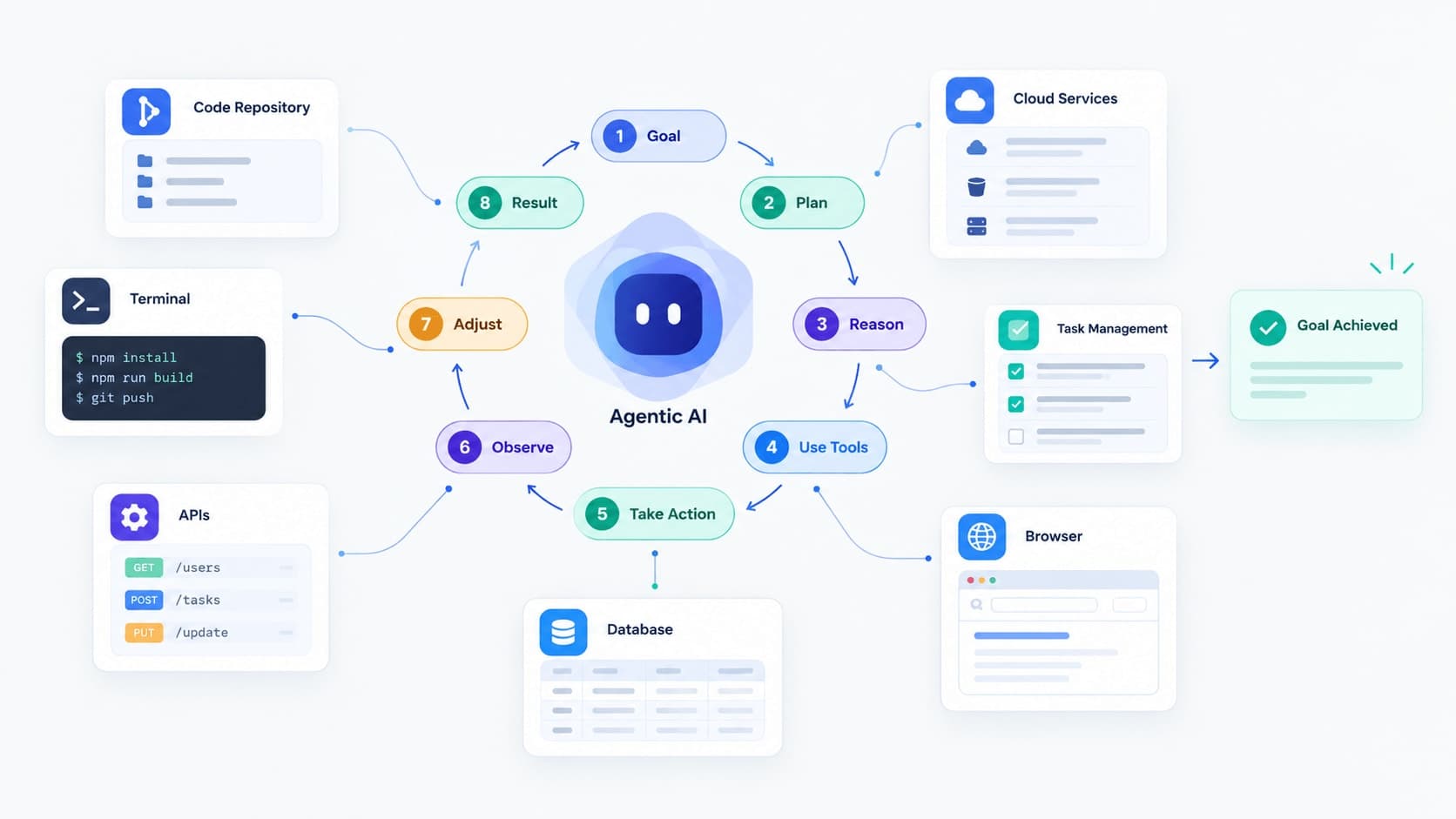
It can write code, use tools, search through files, run commands, analyze errors, interact with APIs, and sometimes even complete an entire task with very little human input.
That is where the term Agentic AI comes in.
And if you're a developer, this is something worth understanding—not because it's another AI buzzword, but because it could change how we actually build software.
So, What Exactly Is Agentic AI?
Let's start with something familiar.
You open ChatGPT and ask:
"Why am I getting a 500 error from my API?"
The AI explains some possible causes.
You then ask it to check your code.
It gives you a suggestion.
You make the change, run the application, get another error, come back to the AI, explain what happened, and continue the conversation.
The AI is helping you.
But you are still doing the work.
Now imagine giving an AI a different instruction:
"Find out why the checkout API is returning a 500 error and fix it."
Instead of simply explaining what might be wrong, an agent could potentially inspect the relevant code, look at logs, check configuration, investigate recent changes, run tests, observe the results, and continue working until it has enough information to complete the task.
That's the basic idea behind Agentic AI.
You give it a goal. It figures out the steps required to reach that goal.
Chatbot vs. AI Agent
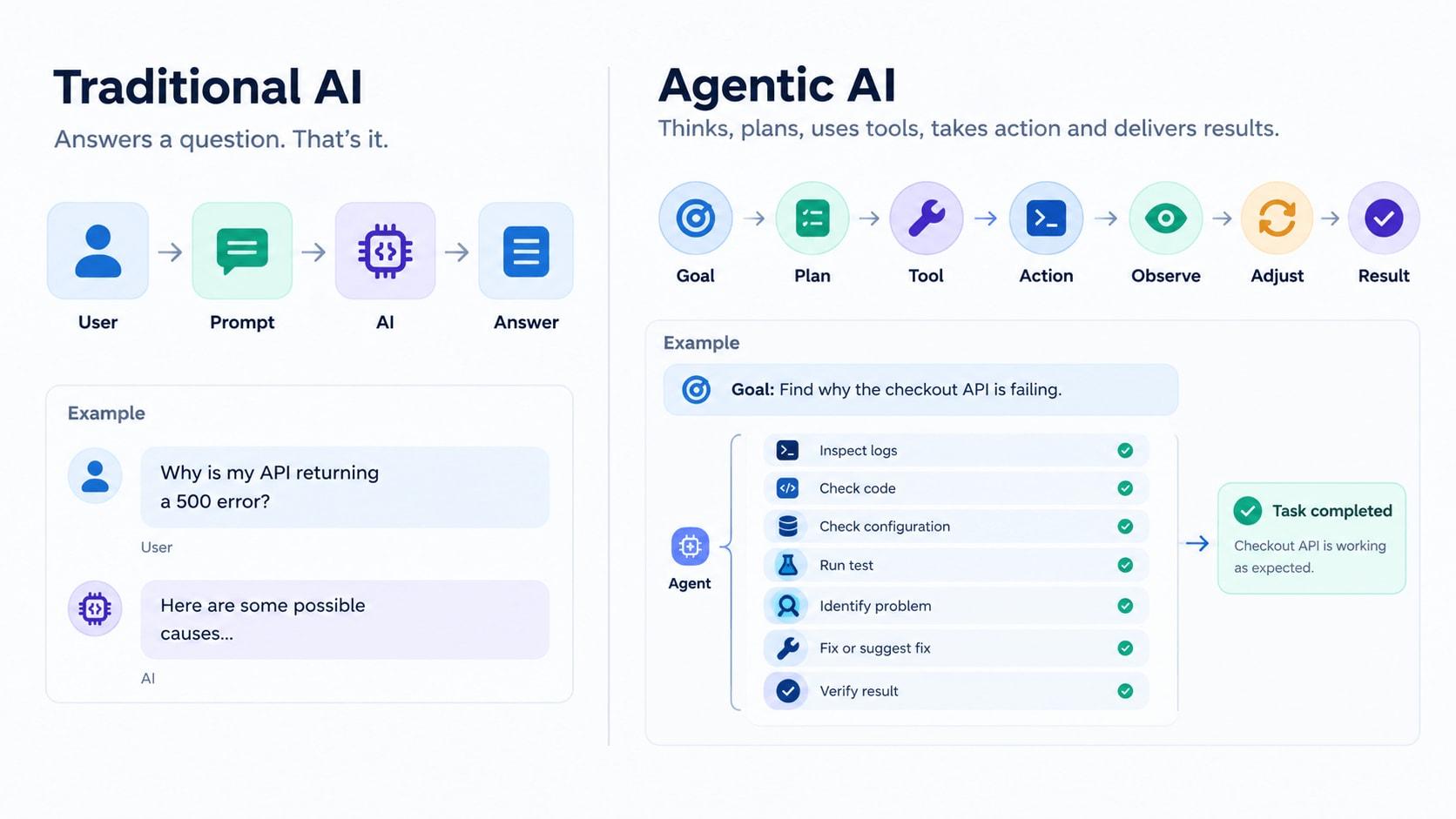
A chatbot primarily generates responses, while an AI agent can plan, act, observe results, and continue working toward a goal.
The easiest way to understand the difference is to look at how they work.
A traditional AI interaction looks something like this:
You → Prompt → AI → Answer
An agentic system looks more like this:
You → Goal → Plan → Action → Observe → Adjust → Action → Result
That's a pretty big difference.
A chatbot is mainly focused on generating a response.
An agent is focused on getting something done.
And that distinction is why developers are paying attention.
But What Makes Something an "Agent"?
Calling something an AI agent doesn't magically give it superpowers.
An agent is usually a combination of several things working together.
First, it needs a goal.
It needs to know what you're trying to accomplish.
Then it needs some form of reasoning or planning to decide what to do next.
It also needs tools.
Those tools could be APIs, databases, files, a browser, a terminal, Git, cloud services, or even internal company systems.
Then comes something extremely important:
Feedback.
The agent needs to see what happened after it took an action.
If something worked, it can continue.
If something failed, it can change its approach.
That's what creates the interesting part of agentic systems:
Think → Act → Observe → Think again.
Instead of one AI response, you get a loop.
Let's Take a Real Developer Example
Imagine you're working on an e-commerce application.
Everything looks fine locally.
But suddenly, customers are reporting:
"Checkout isn't working."
You check the API and see:
POST /checkout → 500 Internal Server Error
Now you have to investigate.
You check the logs.
You inspect the checkout service.
You look at the payment integration.
You check recent deployments.
Eventually, you discover that the payment provider's credentials were changed during a deployment.
The application is still using the old credentials.
That's a fairly normal debugging process for a developer.
Now imagine an AI agent that has permission to access the relevant logs, repository, configuration, and testing environment.
You could give it the goal:
"Investigate the checkout failures and identify the root cause."
The agent could start investigating.
It finds the 500 error.
It checks the logs.
It notices authentication failures from the payment service.
It checks recent changes.
It finds that the credentials changed.
It connects the two pieces of information.
Then it reports:
The checkout service is failing because the payment provider credentials no longer match the configured credentials.
That's much more interesting than simply asking an AI:
"What causes a 500 error?"
The agent isn't just telling you what could be wrong.
It's investigating what is wrong.
This Is Where Things Get Interesting for Developers
Here's the part I find most interesting.
Software development has always been more than writing code.
Think about what you actually do during a normal development task.
You might:
Read a requirement
Search through a repository
Find the right files
Understand existing code
Check an API
Modify several files
Run tests
Fix errors
Check logs
Review the changes
Create a commit
Deploy the application
Writing code is only one part of the process.
And this is exactly where AI agents become interesting.
Instead of:
"Write this function."
You can start thinking in terms of:
"Implement this feature, follow the existing architecture, update the tests, and make sure everything passes."
That's a much bigger task.
And AI agents are being designed to handle these kinds of multi-step workflows.
Does That Mean Developers Will Stop Coding?
Not really.
At least, that's not the interesting question.
The bigger question is:
What will developers spend their time doing when AI can handle more of the repetitive work?
If an agent can create a component, run tests, find an error, fix it, and repeat the process, the developer's job doesn't simply disappear.
The developer still needs to decide:
What should be built?
Is the implementation correct?
Is the architecture appropriate?
Is it secure?
What happens in edge cases?
Can this code be maintained?
Should the AI be allowed to make this change?
Is the result actually what the business needs?
In other words, the developer may move further away from typing every line of code and closer to directing, reviewing, and designing the system.
That's a meaningful shift.
But There's a Catch
Giving AI more autonomy also creates a new set of problems.
Imagine an AI that can modify your code.
That's useful.
Now imagine it can also deploy that code.
More useful?
Maybe.
Now imagine it can access your production database.
Suddenly, the conversation changes.
The question is no longer just:
"Can the AI do this?"
It becomes:
"Should the AI be allowed to do this?"
That's why agentic AI isn't only about making models smarter.
It's also about permissions, security, testing, monitoring, approvals, and knowing exactly what an agent is doing.
A small mistake from a chatbot might give you a bad answer.
A mistake from an autonomous agent could potentially change your application, delete data, expose information, or deploy broken code.
The more power you give an agent, the more carefully you need to control it.
So, Why Is Everyone Talking About Agentic AI?
Because AI is moving from generating things to doing things.
We've already seen AI become good at generating text, images, and code.
The next step is giving AI the ability to work with the systems around it.
Code repositories.
APIs.
Databases.
Browsers.
Terminals.
Cloud infrastructure.
Business tools.
That's what makes agentic AI different.
It's not just about having a smarter chatbot.
It's about building systems where AI can participate in actual workflows.
What Should Developers Learn?
You don't necessarily need to become an AI researcher.
But understanding how AI agents work is becoming useful for developers.
Start with the fundamentals:
Understand how LLMs work.
You don't need to know every mathematical detail, but understand concepts like tokens, context windows, tool calling, and structured output.
Learn how tools connect to AI.
An agent becomes much more useful when it can interact with APIs, databases, files, and other systems.
Understand context and memory.
An agent needs the right information at the right time. Giving an AI more information isn't always better.
Learn about permissions and security.
If an AI can take actions, you need to understand what it should and shouldn't be allowed to access.
Learn how to evaluate AI-generated work.
Being able to verify an AI's output may become just as important as generating it.
The Bigger Picture
The most interesting part of Agentic AI isn't that AI can write code faster.
We've already seen that.
The interesting part is that the interface between humans and software is changing.
For decades, we have interacted with computers through applications, buttons, menus, commands, and code.
Now we're increasingly giving software a goal and allowing an AI system to figure out how to accomplish it.
That doesn't mean developers become unnecessary.
It means the way we build software may change.
And honestly, we're still very early in figuring out what that looks like.
AI agents aren't just another coding tool.
They're a new way of interacting with software.
And that's probably why every developer should at least understand what they are.
Recommended articles for you.

Will AI Take My Job? An Honest Look at the Future of Work
It's the question keeping millions of people up at night. You've seen the headlines. You've probably used ChatGPT yourself. And somewhere in the back of your mind, a small but persistent voice asks: "Am I next?"

Top 20 JavaScript Interview Questions
A practical guide covering the top 20 JavaScript interview questions every developer should understand, including closures, event loop, promises, async/await, and modern JavaScript concepts.

How I Use AI to Build High-Performance Web Applications (2026)
A practical guide on how I use AI in React, Next.js, and Node.js projects to improve performance, scalability, and developer productivity without sacrificing architecture or UX.